

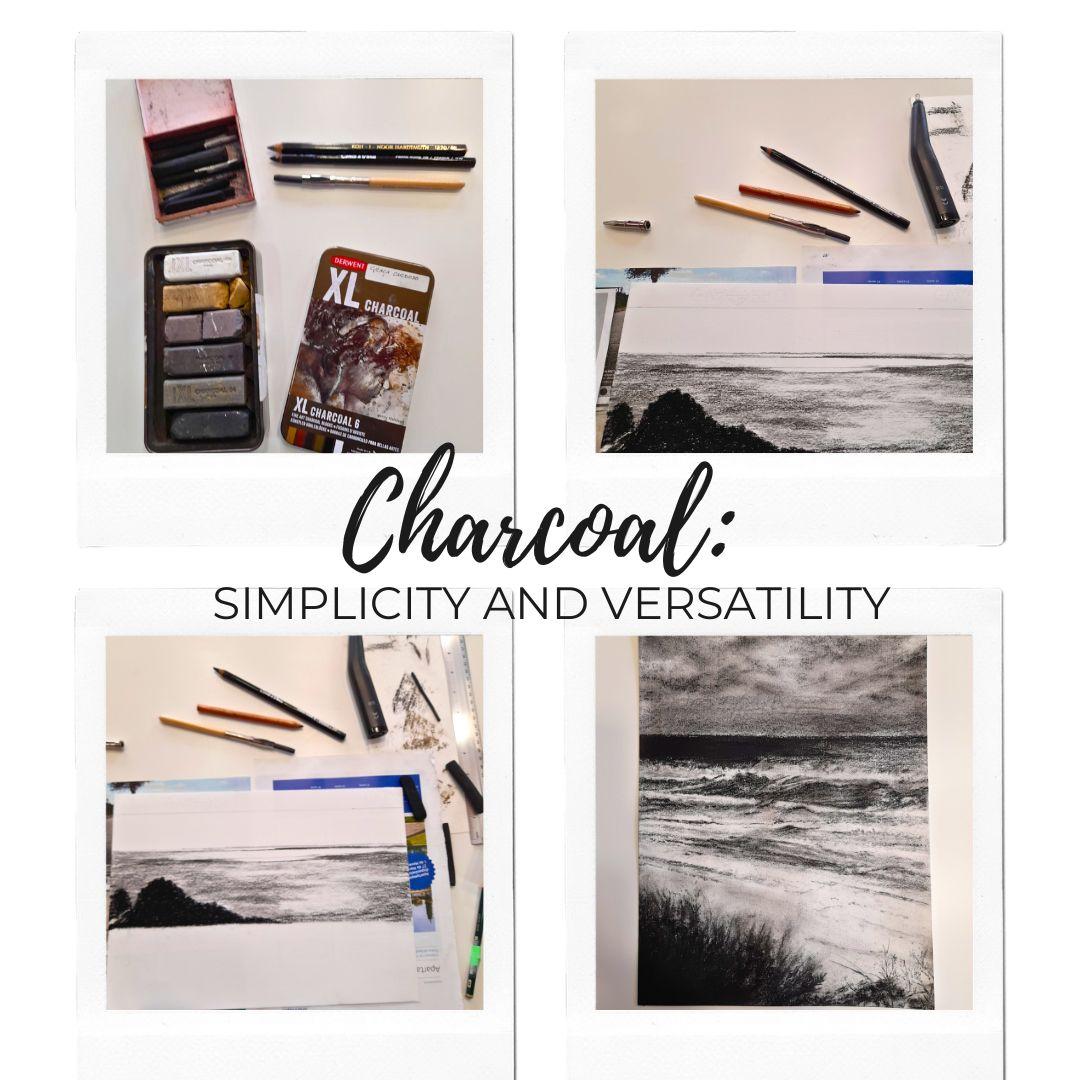
WHAT IS CHARCOAL? CHARACTERISTICS
Charcoal is a simple medium, it’s just a piece of black carbon.
It is made from selected wood, which is first carefully dried and then
charred in an airtight container.
It is a soft material that pulverizes when applied to a support.
Some of its characteristics are simplicity, ease of making corrections, versatility, etc..
2. “ NATURAL “ CHARCOAL/ COMPRESSED CHARCOAL
“ NATURAL” CHARCOAL is produced directly by slowing burning tree branches.
COMPRESSED CHARCOAL is produced from natural charcoal ground to a fine powder and mixed with a binder; it can have various shapes: round, square or rectangular;
it may also be in a pencil form;
allows you to express countless colours and nuances, from light grey to deep black;
allows for deeper blacks than NATURAL CHARCOAL, which has a unique bluish-grey colour
However, “NATURAL “ CHARCOAL fades less and therefore allows for fewer variations in tone than COMPRESSED CHARCOAL.
3. THICKNESS AND DEGREES OF HARDNESS
Charcoal comes in different thicknesses and with different degrees of hardness (there are hard charcoals and softer charcoals).
4. GOOD QUALITY CHARCOAL
Good quality Compressed Charcoal is characterized by its deep black colour.
The charcoal should not crumble when drawing.
5. SURFACES FOR WORKING WITH CHARCOAL
Various surfaces can be used to work with charcoal:
- Paper with a textured surface (pastel paper, watercolour paper)
- Prepared canvas panel
- Good quality drawing paper (prepared with gesso or covered with a good gouache or acrylic paint)
- For quicker sketches or studies you can use cheaper paper (packaging paper, Kraft paper, …); in this case you should use the side of the paper that has more texture.
- Once the paper has been prepared, it must dry; only once it has dried can you wok on it with charcoal.
- When choosing a paper for an important work, you should pay attention to its degree of resistance to light.
6. TECNIQUES AND ADDITIONAL TOOLS
We can create different effects on the surface by using additional tools such as: bread erasers, plastic pencil erasers, drawing cloths, tortillons, specific brushes, etc..
A charcoal drawing can also be worked with water.
7. CHARCOAL’S COMPATIBILITY WITH OTHER MEDIA
Charcoal is compatible with several other media: pastel pencils, soft pastels, gouache, watercolor, acrylic paint, etc..
8. SIMPLICITY AND EXPRESSIVENESS
Charcoal drawing allows for a unique expressiveness with simplicity of means.
9. FIXATIVE
Since charcoal strokes are fragile, they need to be fixed to preserve them. Therefore, when the work has been finished it is mandatory to use a fixative. Sometimes you should use the fixative while the work is in progress. The fixative must be used in a well-ventilated space..
NOTE:
Here we are referring to charcoal in its traditional forms – “ natural “ charcoal and compressed charcoal. Charcoal is also available as:
- Charcoal pencils
- Conté crayon
- powder (*)
- liquid charcoal (*) (from Schmincke or from Nitran).
(*) These two can be worked with water.
Reference books:
- “ Tecniques du dessain”, Beaux Arts - Série Pratique, 1988
- Artistes Magazines No 133, 2008
- “Drawing with Charcoal“, by Kate Boucher, 2021
 EN
EN  PT
PT